| |
Desirable traits |
Acceptable but less desirable traits |
Unacceptable/ Disqualifying Traits |
| HEAD: |
- Slender and triangular head
- Clear of wool forward of the horns
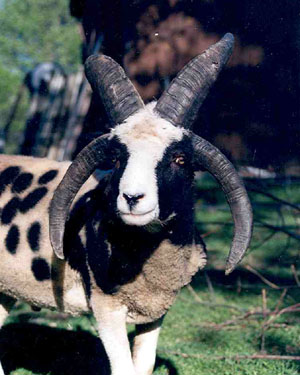
- Large symmetrical eye patches incorporating the cheeks
- Clear white blaze from poll to muzzle
- Straight profile
- Nasal septum and mouth should be dark pigmented in
adults even though the muzzle patch may be absent
|
- Having only one of the three facial markings
- Slipped (below the eye) eye patch or patches
- Pink noses
- Slight tendency to Roman nose
- Young lambs, up to a maximum of 6 months of age, showing baby wool
forward of the horns
|
- Absence of facial markings
- Wool forward of the horns
- Large, square non-Jacob looking head
|
| EARS: |
- Small, erect and slightly above the horizontal
- White, colored or spotted
|
- Slightly larger but proportional to body
|
- Large pendulous ears and/or disproportionate to body
|
| EYES: |
- Clear, bright eyes, no evidence of split upper eyelid deformity
- Color: brown, blue, or marbled
|
- Grade 2 or 3 split upper eyelid deformity causing no injury to the
eye which would require surgical intervention
|
- Grade 3 split upper eyelid deformity or more, causing discomfort or
injury to eye
- Wide, broad bone structure between the eyes
|
| HORNS: |
- Color: black or black and white striped
- Rams:
- Any number provided they are well differentiated (cleanly separated)
and balanced
- Flesh between horn bases
- Two horned rams should have wide, well spaced horns with good
clearance of checks, nose, and mouth at maturity
- Lower horns should be well spaced from face, cheeks and neck
- Ewes:
- Horns firm, fine featured with femininity, balanced, and well differentiated
|
- Rams:
- Fused even horns
- Slightly forward tipping horns which do not impair grazing
- Insufficient spacing between upper and lower horns (must be differentiated
and balanced though flesh may not be present)
- Ewes:
- Unbalanced horn set
- Fused horns
- Ewes with scurs in place of lower (secondary) horns
|
- Polled sheep, or sheep with scurs only.
- Two-horned rams having small, weak, feminine looking horns.
- Multiple-horned rams having fewer than four strong horns, with scurs
in upper or lower horn position. (it is fully acceptable for rams with
at least 4 or more strong balanced horns to have additional scurs or
horn buds)
- Two-horned ewes having small or weak horns.
- Multiple horned ewes having scurs in the primary/top horn position
- Solid white horns
- Forward pointing horns curling towards the eyes, or growing over the
nose impairing the ability to graze naturally
- Narrow or close horns on two horned rams that lack space between
the growing horns and his neck or jaw, encumbering his well being
- Undifferentiated and unbalanced set to four horned rams, i.e., fused
in an irregular pattern on one or both sides
- Small, feminine horns on rams
- Lower (lateral) horns that grow into the face, cheek or neck
|
| NECK: |
|
|
|
| TAIL: |
- The natural Jacob tail reaches almost to the hock
- Is wooly, not hairy
|
|
|
| LEGS: |
- Set square on all corners, standing firm, well-balanced
- Fine boned and of medium length
- Free of wool below the knees
- Color: white with or without colored patches
- Hooves are black or striped
|
- Slightly cow hocked
- One to three dark colored legs
- White hooves
|
- All dark colored
- Wool present below the knees and hocks
|
| BODY CONFORMATION: |
- Mature rams weigh between 120 and 180 lbs.
- Mature ewes weigh between 80 and 120 lbs.
- Long framed, smooth muscled with well-sprung ribs
- Fine boned with straight back
- The rump slopes toward the tail head
- Rams have short scrotums holding testicles closer to the body than
modern breeds
- Ewes have small udders held closer to the body than modern breeds
|
|
- All conformational and/or congenital defects leading to unsoundness
for breeding
- Large, heavy boned
- Fat or short tailed
- Rams over 180 lbs.
- Ewes over 130 lbs.
- Long, pendulous scrotal sacks on rams
- Large, loosely attached udders on ewes
- Excessively large teats on ewes
|
| BODY COLOR and FLEECE: |
- The Jacob is a randomly spotted sheep, basically white with colored
spots or patches
- Preferably an approximate 60% white and 40% black or lilac spotting
- Skin beneath white fleece is pink, skin beneath colored spots dark
- Fleece is a medium grade with an open character and soft springy handle
(Bradford count 44-56, demi-luster / 26.40-36.19 microns)
- Fleece staple length is 3-7 inches, fleece weight 3-6 lbs, with little
grease and high yield
|
- Random colored patches on front half of body only
- Not less than 15% colored markings nor more than 85% color
- Patches of color with some bleeding, mottling or freckling
- Small amount of freckling in white wool
- Small amount of kemp
|
- Fleeces grading 60 Bradford count or higher (23.50 microns or finer)
- Fleeces grading 40 Bradford count or lower (38.09 microns or coarser)
- Double coating
- More than 85% colored markings
- Less than 15% colored markings
- Short, brittle fleeces with heavy kemp
- Fleeces on adult sheep which shed
- Fleeces weighing 8 lbs. or more
- Excessive quilted appearance to the fleece (where the dark fibers are
shorter than the white or vice versa) occurring after the first shearing.
- Excessive freckling in the white wool of young animals
|